The quick version
- Tall, and it breaks into dozens of separate strands on the way down.
- No hike. The coach parks and the falls are in front of you.
- Enough to walk to the base and back if you go straight there.
- Told here as folklore, which is what it is.
What it actually is
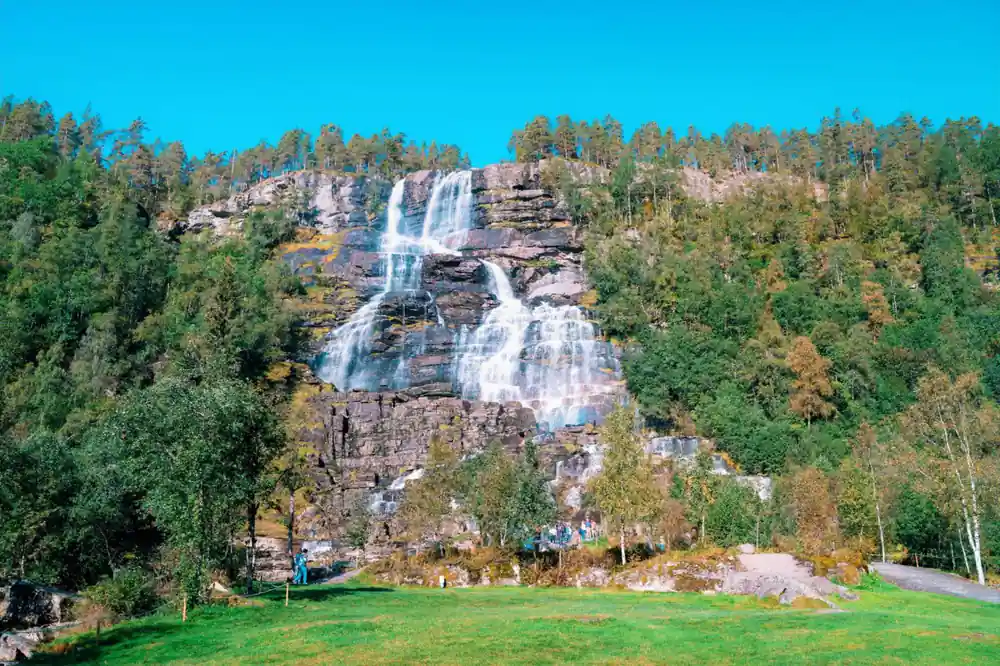
Tvindefossen drops around a hundred and ten metres down a broad, stepped rock face a short way north of Voss, and the thing that makes it distinctive is not the height but what the rock does to the water.
Instead of falling as one mass, the flow splits across the face into dozens of separate threads and veils, spreading sideways as it descends and reassembling in the pool at the bottom. The face is mossy and green where the water is thin, white where it is not, and the whole thing reads more like lace than like a river.
It sits directly beside the main road with a car park, a path and a campsite, which is why it gets twenty minutes on an itinerary rather than a day. Accessibility has made it slightly underrated: a waterfall you can reach without effort is easy to treat as a photo opportunity rather than a place.
Flow varies a great deal with the season. In late spring, with snowmelt coming off the high ground, the face carries far more water and the separate strands merge into something closer to a curtain. By late summer it is thinner, more delicate and arguably more interesting, because that is when the structure of the rock underneath shows through.
Twenty minutes, and how to use them
The stop is short and the mistake is predictable. People get off, photograph the falls from beside the coach, buy something, and get back on.
The better use is to walk. A path leads from the parking area towards the base, it takes only a few minutes, and it changes the experience completely: from the bottom the individual strands separate out, the sound arrives properly, and the scale becomes obvious in a way it never is from the road.
You can get close enough to feel the drift of spray on a still day, which is the point at which people stop taking photographs and just look at it. Then walk back, and you will still be early.
Wear something with grip if it has been raining. The path is short and easy, and the rock beside it is not.
There are toilets at the stop, and this is the place to use them: the next scheduled opportunity is Gudvangen, which is the better part of an hour further on down the valley.
Water breaking into strands down a dark face
The legend, told as a legend
The water at Tvindefossen has a long-standing local reputation for restoring youth, and it is sold in bottles nearby on exactly that basis.
It is folklore. There is no evidence for it, nobody serious claims otherwise, and it belongs to the same family of stories as every other spring in Europe with a queue in front of it. Guides tell it because it is a good story and because visitors ask.
What is true is that the water is clean glacial and snowmelt runoff off a Norwegian mountainside, and that people fill bottles from it. Treat the rest as decoration rather than as a claim.
The story is worth knowing before your guide tells it, mostly so you can enjoy it as a story rather than wondering whether you are being sold something.
The photograph
Two positions are worth knowing, and they produce completely different pictures.
From near the car park you get the whole fall in frame with the road, the grass and the trees for context, which is the postcard and which everyone takes. It works best with a person somewhere in the lower third, because otherwise there is nothing to establish that the face is a hundred metres high.
From the base, looking up, you get the strands. The whole fall will not fit and should not: the interesting picture is a section of the face where the water separates and rejoins.
Overcast days are better than bright ones here. Direct sun blows out the white water and throws the mossy face into shade, and the flat grey light that western Norway supplies most of the time is exactly right for it.
110 m
The drop at Tvindefossen. The rock face splits it into dozens of separate threads on the way down, which is why it looks like lace rather than a river.
Is it worth the stop
Yes, and more than the itinerary implies.
On a day whose headline is a UNESCO fjord and an architectural viewpoint, a roadside waterfall reads as a convenience break, and that is a shame. In most countries a hundred-and-ten-metre fall with a path to its base would be the destination rather than the interruption.
It is also the first real stop of the morning, three hours into a twelve-hour day, and the difference between standing at the bottom of it and photographing it from the tarmac is the difference between having been somewhere and having driven past it.
Go straight to the path. That is the entire advice.
One more reason to take it seriously: it is the only waterfall on this itinerary you stand underneath. Everything else you will see today is viewed from a boat deck, a coach window or a platform six hundred metres above it.
A hundred and ten metres, and twenty minutes to meet it
from US$310Reserve now & pay later