The quick version
- A viewpoint looking straight back down the way you came in the morning.
- Thirteen hairpins and a gradient that makes it notorious.
- Rockfall work has closed it in recent years. Ask on the day.
- You come back over the high ground, not along the morning road.
What Stalheim is
Stalheim is a shoulder of high ground at the head of the Naeroydalen valley, and it is one of the oldest viewpoints in Norway in the literal sense: people have been stopping here to look at this for as long as there has been a route through.
There has been an inn on the site for centuries, because this was a staging point on the postal road long before anyone came for the scenery. The hotel that stands here now is a large building in a position no modern planning process would ever grant, and it exists because the view was recognised early.
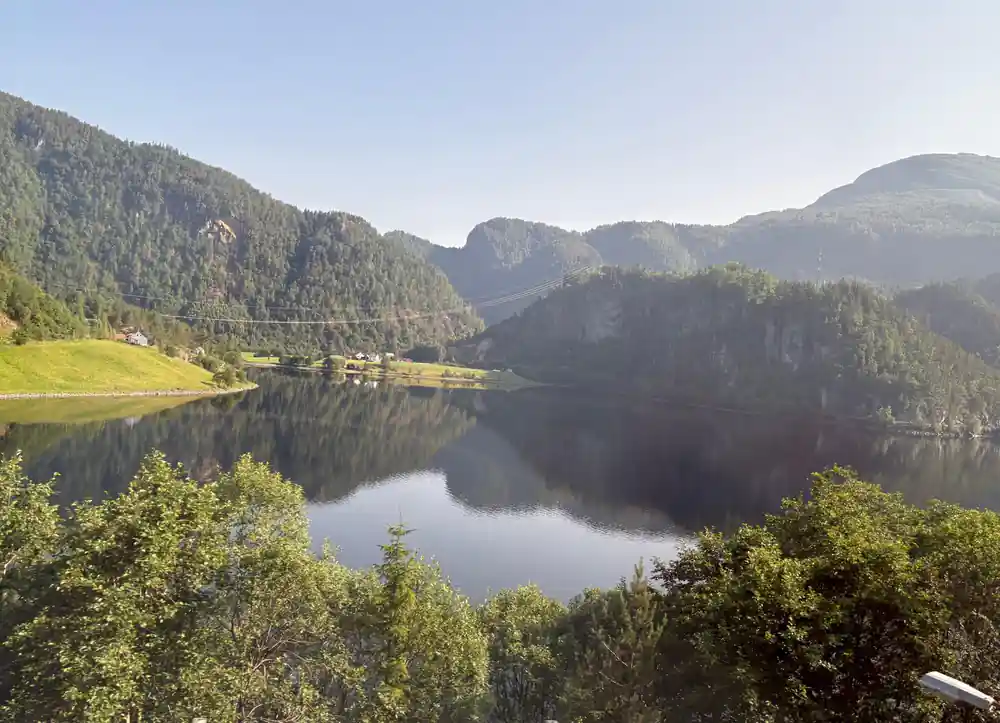
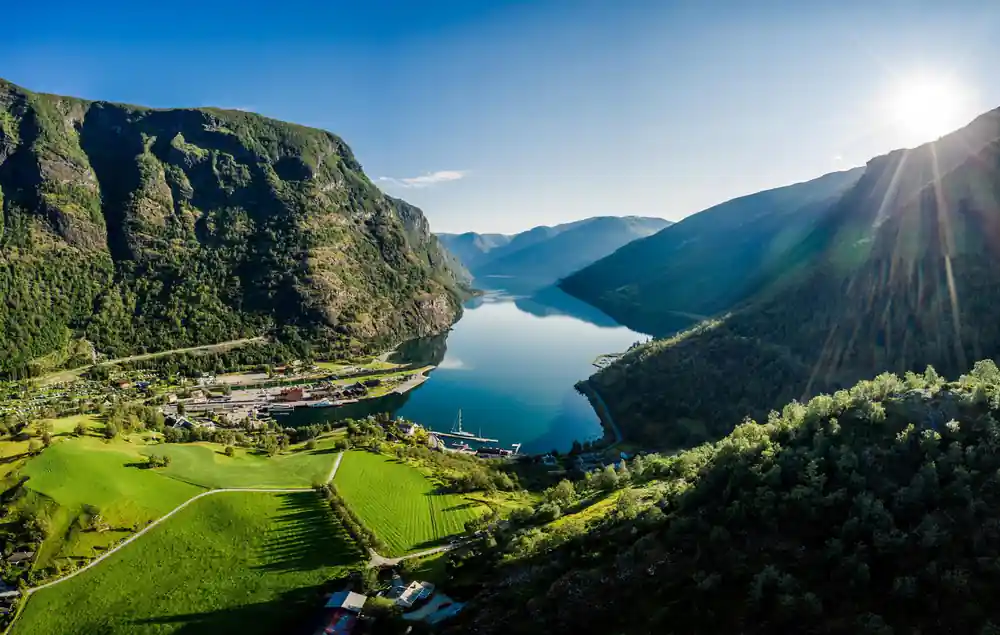
What you are looking at from the terrace is the valley you drove up in the morning, seen from above: a flat green floor between two walls, with waterfalls on both sides and the road threading along the bottom of it. It is the single best explanation of the day's geography that the itinerary offers.
The name attaches to the whole shoulder of ground rather than to any one building, which is why you will see it used for the hotel, the viewpoint and the old road interchangeably. On this itinerary it means the stop at the top.
The road that made it famous
Below the hotel, the old road drops into the valley in a series of hairpin bends cut into the hillside. Thirteen of them, with gradients steep enough that the road has a reputation across northern Europe.
It was built in the nineteenth century, by hand, to get horse traffic between the valley floor and the high ground, and it has been a piece of engineering folklore ever since. Coaches used to descend it as the highlight of the tour, with passengers counting the bends.
Its status has changed. Rockfall on the slope above led to safety work and closures in recent years, and whether traffic uses it in any given season is not something to state confidently in writing. Modern tunnels carry the through route regardless, which is why the day works either way.
So treat it as something to ask your guide about on the morning rather than something to expect. If it is running, it is memorable. If it is not, you still get the view from the top, which is the better half.
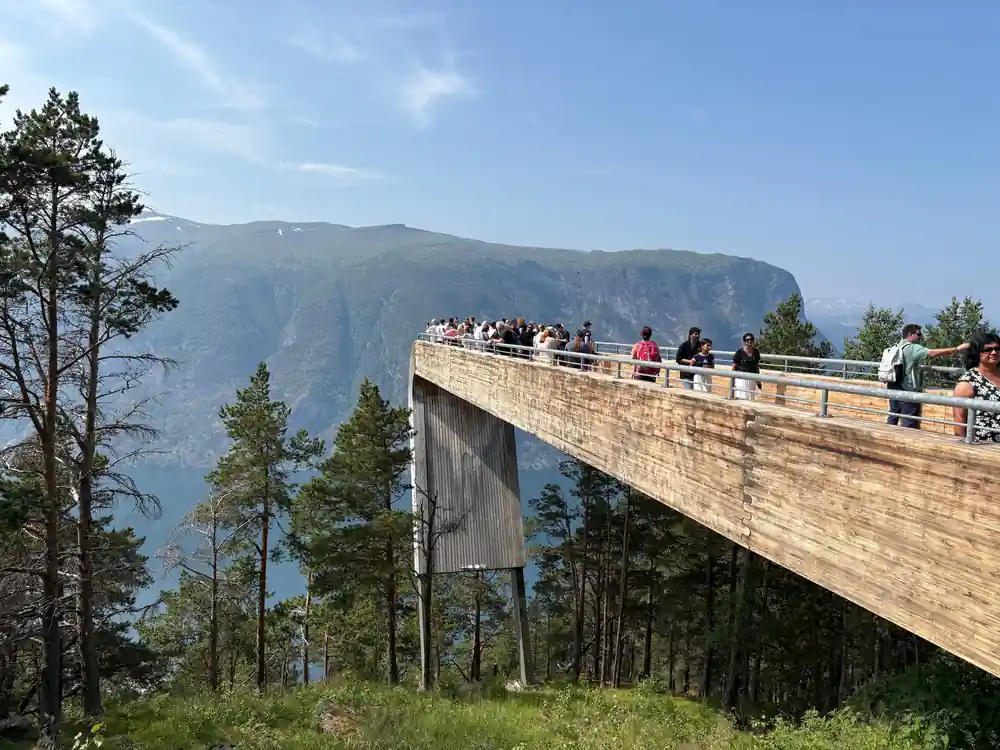
A valley seen from high above with a road below
Why the return goes a different way
The morning route and the afternoon route are not the same road, and that is deliberate rather than accidental.
Coming out of Flam and down from Stegastein, the coach picks up the road over the high ground rather than retracing the fjord-side run of the morning. That gives you the Naeroydalen valley from above instead of from the floor, which is a completely different view of the same place.
It is a small thing that makes a real difference on a twelve-hour day. Nobody wants the last two hours to be scenery they already looked at in the morning, and this itinerary avoids that by design.
It also means the seat advice reverses. The side that had the water in the morning is not the side with the drop in the afternoon, and people who worked that out at Stegastein change places for the run home.
The stop itself
It is short, around fifteen minutes, and it is a stretch and a view rather than an activity.
Walk to the edge of the terrace and look down the valley. That is the whole of it, and it is enough. There are facilities and something to buy, and by this point in the day most people want a coffee more than they want a photograph.
The light in the late afternoon here is usually the best of the day, particularly in the shoulder seasons when the sun is low enough to come down the valley rather than over it.
If the weather has closed in, you may get nothing but cloud, and that is a real possibility rather than bad luck. This is high ground in western Norway and the view is not guaranteed at any specific hour.
It is also the last stop of the day. Anything you have been meaning to buy, ask or photograph happens here, because after this the coach runs to Bergen without stopping.
Thirteen
The hairpin bends on the old road below Stalheim, cut into the hillside in the nineteenth century. Its gradient made it one of the steepest roads in northern Europe.
The last two hours
From Stalheim it is roughly two hours back to Bergen, and it is the quietest stretch of the day.
The road runs back through Voss and down towards the coast, retracing part of the morning's ground in the final section. By then most of the coach is asleep, which after a twelve-hour day starting at half past seven is entirely reasonable.
Arrival in Bergen is in the evening and the exact time depends on the roads. The operator is explicit that delays happen here, and the sensible response is to have nothing booked for that evening.
The last useful piece of advice is a small one: keep a layer to hand rather than in the hold. Coaches get cold on a long evening run, and the bag you packed for a boat deck is the one you want on the last hour home.
The valley from above, on the way home
from US$310Reserve now & pay later