The quick version
- Directly above the Aurlandsfjord, reached by a mountain road.
- It runs straight out from the hillside with nothing underneath.
- A glass panel angled towards the water instead of a railing ahead.
- Designed as a building, opened in 2006, not a lay-by with a fence.
What it is
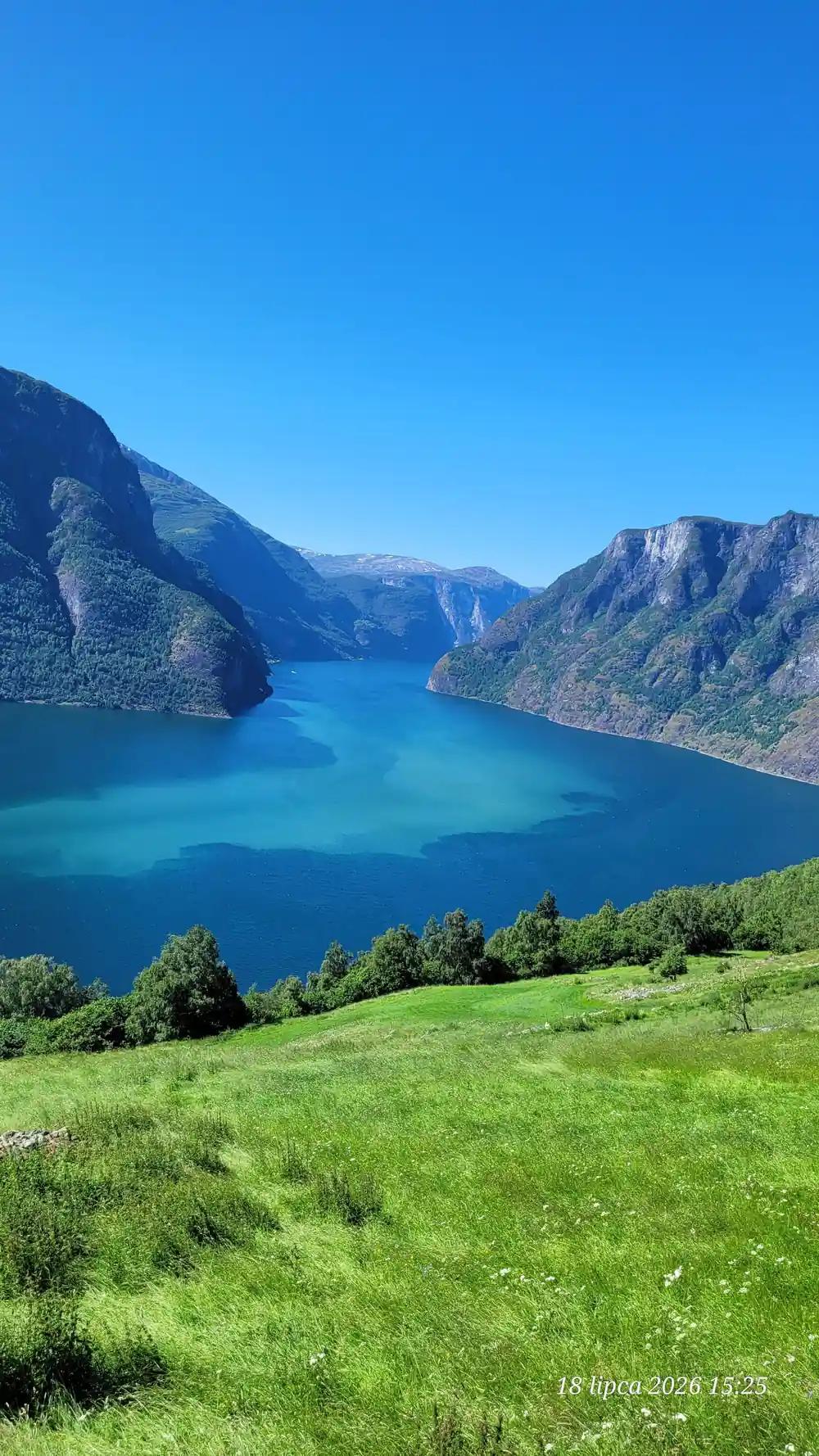
Stegastein is a viewing platform on the mountain road above the Aurlandsfjord, and it is a piece of design rather than a parking space with a view.
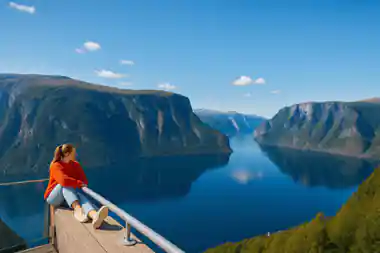
A deck of laminated pine runs thirty metres straight out from the hillside, unsupported for most of its length, at a height of around six hundred and fifty metres above the water. There is a timber rail along the sides. At the far end there is no rail at all: the deck curves downward and finishes in a sheet of glass angled towards the fjord below.
It was designed by the architects Todd Saunders and Tommie Wilhelmsen and opened in 2006, and it has been widely published since, which is why it looks familiar to people who have never heard its name. The material is deliberate. Timber weathers, greys and belongs to this landscape in a way that steel and concrete would not.
The setting does half the work. The platform stands on a slope of birch and rock with nothing built anywhere near it, so there is no car park, no cafe terrace and no other structure in the frame. Whatever you photograph here is timber, air and fjord.
The detail that makes it work
The downward curve at the end is the whole idea, and it takes about four seconds to understand once you are standing on it.
An ordinary viewpoint stops you with a barrier at chest height, so your last impression is of the barrier. Stegastein removes it. Walking out along the deck, the floor falls away in front of you and the only thing between you and six hundred and fifty metres of air is glass angled downward, so your eye is pulled over the edge and down to the water rather than stopped at a rail.
The result is that you feel the height rather than merely see it, which is exactly what the building is for. People walk out confidently, reach the last few metres and slow down.
It is completely safe, thoroughly engineered and entirely unnerving, and those three things are not in conflict.
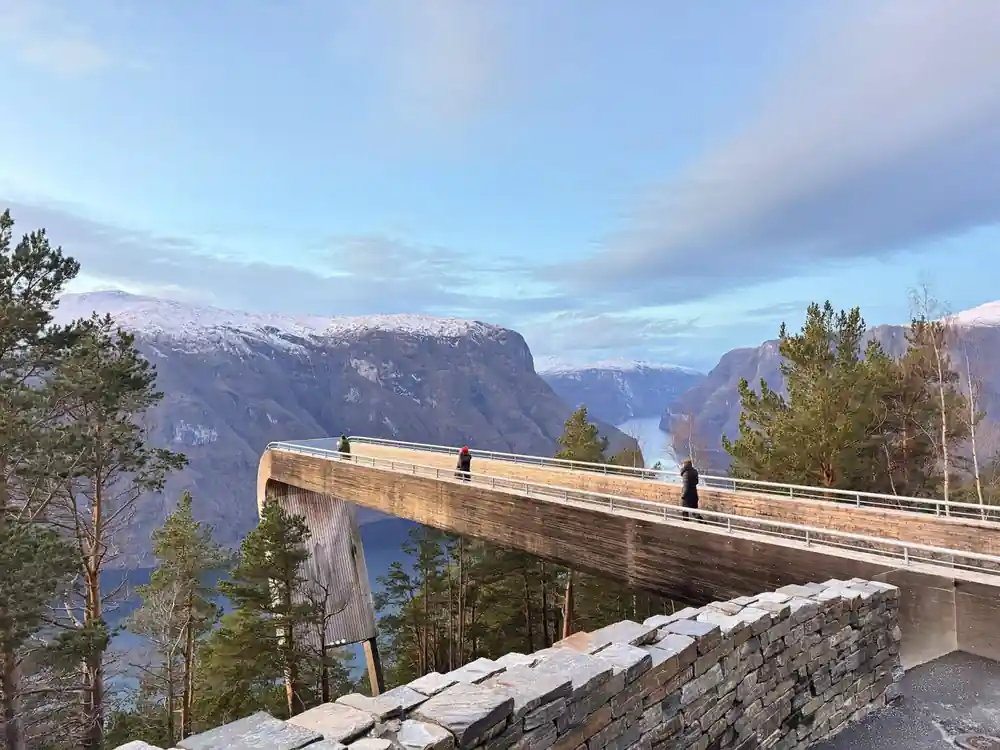
The platform running out from the hillside
The road up
Getting there is part of it. The road climbs from the fjord in a series of tight bends, gaining six hundred metres in a distance that looks absurd on a map, and it does it in a full-size coach.
This is the Aurlandsfjellet road, the one that carries on over the mountain plateau to Laerdal and is closed for much of the winter up there. The tour only uses the lower section to the viewpoint, which is open far longer.
From inside the coach the bends are entertaining rather than alarming, and the drivers do this several times a day. What is genuinely worth watching is the view opening up behind you as the fjord drops away, which happens gradually and then all at once.
Anyone prone to travel sickness should take something before Flam rather than at the first hairpin. The climb is short, but it is switchbacks the whole way.
Thirty minutes at the top
The stop is around half an hour, which is more than enough and correctly judged.
Walk out to the end first, before the platform fills, and then come back and take your photographs from partway along. The most useful frame is not the view from the platform but the platform itself, seen from the path beside it, with people on it for scale.
There is a small building with facilities and something to buy. It is at six hundred and fifty metres in a place with real weather, and it can be cold and windy when Flam was mild, so take the layer you had on the boat rather than leaving it on your seat.
The light matters here more than anywhere else on the itinerary. A clear afternoon gives you the fjord in full. Low cloud gives you something arguably better: a platform running out into nothing with the water appearing and disappearing below.
It is worth walking the short path above the platform as well as onto it. From slightly higher you get the deck, the drop and the fjord in one frame, which is the photograph that actually explains the place to somebody who was not there.
650 m
The height of the Stegastein platform above the Aurlandsfjord. Thirty metres hangs out from the hillside, and the last of it turns down instead of stopping at a rail.
Is it frightening
For some people, yes, and there is no reason to pretend otherwise.
The deck is wide, solid and railed along both sides, and there is no sensation of movement. What gets people is the end: the floor drops away, the glass leans out over the drop, and the brain objects even though nothing about it is unsafe.
Anyone uncomfortable with heights can walk partway and stop, and will still have seen the fjord from six hundred and fifty metres. The view does not require the last ten metres of deck.
Children are fine here with an adult, and the rails are designed with that in mind. The one thing worth doing is warning a nervous member of your group before they walk out, rather than letting them discover the missing rail at the far end.
Six hundred and fifty metres, and nothing under the last of it
from US$310Reserve now & pay later